To: NSCEB leadership; Senator Todd Young; Michelle Rozo, PhD; Rep. Chrissy Houlahan; Rep. Ro Khanna; Rep. Deborah Ross; Rep. Stephanie Bice; Rep. Jim Baird; Rep. David Rouzer; Rep. Pete Sessions; Rep. April McClain Delaney; Rep. Don Davis, and the federal and state implementers standing up biomanufacturing Centers of Excellence (COE), hubs, and investment programs.
January 21, 2026
Why “Centers / Hubs / Capital” will fail without a shared operating architecture, and how to fund 10-15 deployable Bio-OS suites as the reference kit
The United States is about to spend real money on biomanufacturing capacity via COE, regional hubs, and an Independence Investment Fund model that can seed private capital. But capacity without shared architecture becomes a patchwork: non interoperable processes, noncomparable data, slow tech transfer, and workforce training that doesn’t travel. This is the same failure mode that makes mammalian biology expensive, brittle, and hard to scale in the first place.
My proposal is straightforward and testable: fund and deploy an initial “Reference Kit” of 10-15 standardized Bio-OS modular suites across 3-4 hubs within 12-24 months as the practical engine behind (1) the Biomanufacturing Excellence Act’s Center of Excellence, (2) NSCEB style hub networks, and (3) Independence Investment Fund-style biotech investments.
The goal: run an architecture level pilot and scale what demonstrably improves speed, reliability, and capital efficiency (not pre adopt a vendor).
Time is of the essence. Multiple analyses and the NSCEB warning are consistent: the competitive race is not about who has one great lab, it is about who can deploy many standardized, high-quality sites quickly.
We can scale compute overnight, but we cannot scale trust in biology without standardization.
1) The policy moment is real: COE / Hubs / Capital are converging
Three policy and program “rails” are forming that, if coordinated, can finally make U.S. biomanufacturing behave like infrastructure:
- A national COE track: The Biomanufacturing Excellence Act of 2025 (House and Senate versions) directs NIST to establish a National Biopharmaceutical Manufacturing COE to advance reliable and efficient biopharmaceutical manufacturing, engage regulators, and support workforce training.
- A hub network track: NSCEB’s broader program framing emphasizes standing up a network of advanced biomanufacturing hubs and scaling capacity, not just funding papers and prototypes.
- A capital deployment track: The Independence Investment Fund Act of 2025 would establish an investment fund at Treasury to make equity investments in critical and emerging technologies, explicitly including biotechnology, to enhance national and economic security.
This is not incremental. This is structural. We are finally seeing biotech treated like chips, power, and logistics: governance, roadmaps, industrial base, supply chain, hubs, and workforce pipelines.
But there is a hard truth: You cannot get infrastructure outcomes from a nonstandard, bespoke technical substrate. This is where U.S. execution typically stalls.
2) The execution gap: why hubs without architecture become “islands”
If we stand up hubs and Centers as collections of one-off equipment stacks, unique SOPs, and lab specific biological environments, we will reproduce the same systemic problems:
- Slow and expensive scale-up: every facility becomes its own tech transfer project, its own validation story, its own workforce retraining loop.
- Non comparable data: “success” in Hub A won’t port to Hub B; regulators won’t get consistent reference datasets; AI won’t train on clean, comparable runs.
- Workforce training that doesn’t travel: skills become vendor specific and site specific, increasing opportunity cost and slowing adoption.
This is exactly why the infrastructure language now appearing in national policy also includes digital infrastructure, regulatory science, and biometrology tools, because measurement and comparability are the difference between an ecosystem and a set of disconnected projects.
3) What I mean by “a shared biological operating architecture”
The U.S. is still trying to run a 3D, dynamic, mammalian system on flat (2D) legacy technologies and bespoke methods and then we act surprised when translation, scale, and reproducibility fail.
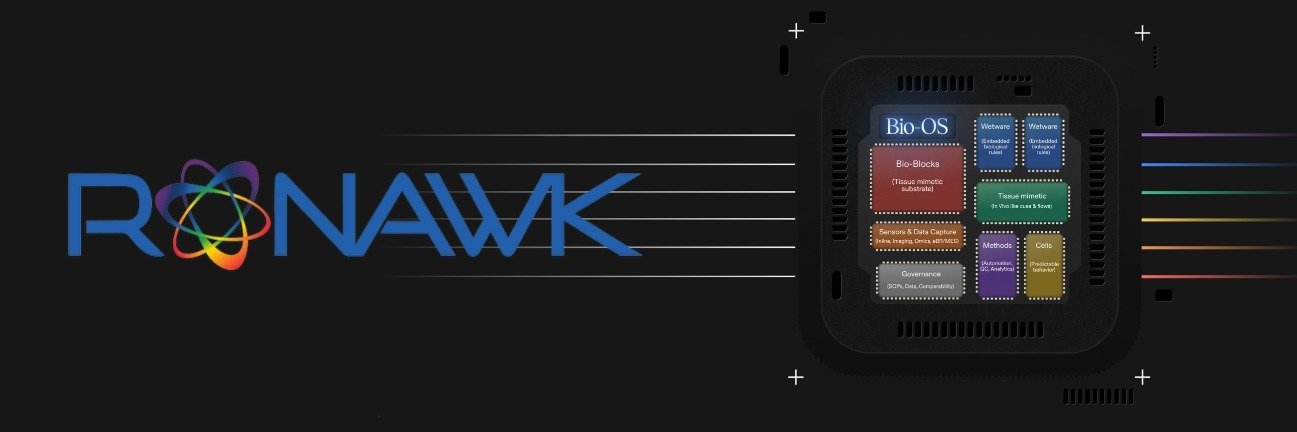
Bio-OS™ is a biological operating platform designed to coordinate biological environments, processes, and data across applications. It enables biology to be produced, assembled, studied, and scaled within a shared, governable framework. We are not standardizing biology, only the operating environment and metadata so biology becomes comparable.
A biological OS has three layers:
- Physical layer (the “biological chips”) human relevant, modular substrates (hydrogels, when treated as foundational materials rather than narrow tools, provide consistent and tunable environments in which biological systems can operate) for mammalian cells manufactured to the same specs everywhere so cells experience comparable environments across sites.
- Process layer (versioned “apps”) Copy and paste, version-controlled protocols that run on that physical layer, so methods are portable across labs, CDMOs, and federal facilities, rather than re-invented each time.
- Data layer (machine readable and regulator auditable) Built in sensing, standardized metadata, and traceable run histories, so every run can be compared, audited, and used for trustworthy model training.
The point is not to impose uniformity on biology. The point is to remove extrinsic variability introduced by tools, environments, and site idiosyncrasies, so intrinsic biological behavior can be manufactured and measured reliably.
4) The “Reference Kit” proposal: 10-15 deployable Bio-OS suites as the backbone
Here is the practical engine that turns legislation into deployable capacity:
The Reference Kit (hardware spec, recipe library, data schema, QA/QC gates, training credential)
Deploy an initial cluster of 10-15 Bio-OS modular suites across 3-4 strategic hubs, focused on medical countermeasures, essential biologics, and high complexity mammalian workflows, installed largely in existing facility shells to compress time-to-capacity.
The logic behind 10-15 deployable suites is that it is the minimum scale at which a hub program becomes infrastructure rather than a showcase. With fewer than 10 nodes, you cannot build a statistically meaningful comparability library, the cross-site dataset that quantifies variance envelopes, proves “copy-exact” performance, and produces regulator and investor trustworthy evidence that an architecture is portable. At the same time, 10-15 suites is the threshold where workforce portability becomes real: you can train and credential operators on a common runtime and then rotate talent across sites without retraining on bespoke stacks, which is essential under current workforce constraints. Finally, that scale enables surge logic, the ability to repurpose capacity across products and missions by moving versioned recipes and QA gates across interchangeable nodes, so surge is not a paper plan but a demonstrated operational capability.
Critically, it is a timeline and scale that can compete. The U.S. cannot wait for 6-8-year bespoke plant cycles when competitors are moving at national program speed.
5) The value proposition for COEs, Hubs, and a Treasury investment vehicle
1. For the Biomanufacturing COE (NIST and partners): The COE mandate is inherently about reliability, efficiency, regulatory alignment, and workforce training. A Bio-OS reference line inside the COE enables: •A “known good” mammalian operating environment that external sites can copy •Canonical data generation for metrology, comparability, and regulatory engagement •Platform training (operators trained on the same architecture deployed nationally)
A Bio-OS reference line inside the COE enables:
- A “known good” mammalian operating environment that external sites can copy.
- Canonical data generation for metrology, comparability, and regulatory engagement.
- Platform training (operators trained on the same architecture deployed nationally).
2. For NSCEB style hub networks: Hubs win when they produce repeatable deployment patterns, not one-off excellence. Bio-OS hubs are designed around the same five lines of effort that NSCEB documents describe: deploy demonstration hubs, integrate into defense strategy, build a data spine, modernize regulatory science/biometrology, and develop workforce pipelines.
3. For the Independence Investment Fund model (Treasury): A Treasury equity vehicle should invest where it can seed private capital by de-risking execution.
A Reference Kit program is de-risking in the most investable way possible:
- standardized deployments,
- repeatable unit economics,
- measurable performance deltas,
- and faster time-to-revenue across multiple sites.
This is what attracts follow on private capital.
6) A funding and implementation plan
A rough but decision useful funding frame is: 10-15 deployable suites x $2.5M-$5.0M CapEx per suite = $25M-$75M in equipment and modular fit out, plus a commissioning and readiness package (validation, QA/QC systems, cybersecurity/provenance controls, and initial data/telemetry integration), workforce build out, and a shared data infrastructure layer for comparability libraries and audit trails. For ongoing operations, assume O&M and staffing are site dependent and should be finalized during hub selection, but a reasonable planning placeholder is a lean two shift “core crew” per suite (operators, QA, maintenance/engineering, and data stewardship) with centralized functions (quality systems, training, and data governance) shared at the hub level to avoid duplicative overhead.
0-6 months: Define metrics and authorize the Reference Kit procurement
Objective: turn “hubs” into an executable procurement spec.
1. Charter a “Reference Kit” requirement for the COE/hub network (e.g., NIST COE as reference anchor and interagency steering committee): a deployable, interoperable mammalian suite architecture (hardware / process / data) that can be replicated. OTA for pilots and IDIQ for scaling.
2. Set outcome metrics that match how infrastructure should be judged: •time-to-qualified output, variability reduction, cost per qualified unit, tech transfer time, workforce portability, data completeness for regulatory/AI use. (These map cleanly to the reliability and comparability problems called out in the policy framing.)
- time-to-qualified output, variability reduction, cost per qualified unit, tech transfer time, workforce portability, data completeness for regulatory/AI use. (These map cleanly to the reliability and comparability problems called out in the policy framing.)
3. Issue a pilot call (COE and hubs) that is architecture neutral in wording but with architecture specific requirements (integrated operating stack, auditability, metadata, security).
6-18 months: Deploy 10-15 suites and run comparative programs
Objective: create real, comparable, regulator usable performance data.
1. Deploy 10-15 suites across 3-4 hubs (e.g., NIST COE anchor, one defense aligned node, one BARDA/health security aligned node, one commercial/academic node).
2. Execute head-to-head runs against legacy workflows for:
- tech transfer time,
- batch variability,
- time-to-result,
- and “switch cost” between products/programs.
3. Build the comparability library: publish reference datasets and metadata schemas suitable for regulatory science and AI training.
18-36 months: Scale winners and formalize standards
Objective: move from pilot to repeatable national deployment.
- Expand to 30-40 suites across 6-8 hubs (adding industrial biomanufacturing modules where appropriate).
- Use AMCs/offtakes where appropriate to turn capacity into predictable demand, especially for defense and health critical biologics. (This aligns with the “network of commercial facilities” and offtake logic discussed in the infrastructure framing.)
- Embed “Reference Kit compliance” into future hub solicitations so capacity additions remain interoperable over time.
7) Workforce: the hidden bottleneck, and why a shared architecture is the only scalable fix
Demand is up sharply, planning data is weak, and the U.S. is not producing enough cross trained, AI ready operators. There are also discipline silos and a lack of “biotech bilingualism” (domain and computational tools).
A hub strategy that ignores this will fail, not because of funding, but because you cannot staff, operate, and validate bespoke systems at national scale.
A shared operating architecture flips the model:
- single platform training that transfers across sites,
- modular credentials aligned to GMP and NAM operations,
- and simulation/digital twin training that reduces the need to “learn on precious GMP time.”
If the national aim is speed, the workforce solution is not “more bespoke training programs.” It is standardized training around a shared infrastructure stack, exactly where the policy appetite is heading.
8) What each stakeholder gets
- NSCEB / Congress: a fundable, measurable way to turn hubs into interoperable capacity fast, while demonstrating a credible response to adversary scale programs.
- NIST COE leadership: a reference architecture that produces comparability libraries, workforce training, and regulator aligned datasets.
- Treasury / Independence Investment Fund proponents: an investable de-risking strategy that can seed private capital around standardized deployments.
- Members of Congress (House / Senate): a concrete “what to fund Monday morning” plan with a 12–24-month deployment horizon and visible national benefit.
- States and regions: a portable manufacturing and NAM capability that anchors workforce pipelines and regional ecosystems without waiting on decade scale greenfield builds.
9) The immediate ask
Appropriate and/or allocate funds for an initial 10-15 deployable “Reference Kit” of Bio-OS modular suites across 3-4 hubs, with the COE as a core anchor and require that the pilot produce comparability libraries, workforce credentialing, and regulator usable reference datasets within 12-18 months of award.
As a next step, I am asking the implementing leads to convene a 60–90-minute working session (COE / hub architects / defense / health stakeholders and workforce leads) to finalize:
- the Reference Kit performance metrics,
- hub site selection criteria,
- and a procurement and evaluation plan that can start in the next budget cycle.
Respectfully, Thomas W. Jantsch
President & COO, Ronawk, Inc.
President & COO, Ronawk, Inc.
On behalf of U.S. practitioners committed to a secure, resilient bio-industrial base
About Ronawk
At Ronawk, we are building a biological operating system (Bio-OS™) that acts as a compass for mammalian biology. Legacy biomanufacturing technologies were designed for microbes like yeast or bacteria. They exhaust mammalian cells, making production inefficient and cost prohibitive. Bio-OS was designed from the ground up for mammalian cells, which are the very cells needed for therapies, biologics, and regenerative medicine.
Instead of burning cells out, Ronawk’s Bio-OS cultivates them in environments that mimic the body. This yields healthier, more potent outputs at a fraction of the cost and footprint of current systems. Find us online at ronawk.com, X (Twitter), and LinkedIn.
Ronawk Media Contact
Scott Leigh
Chief Business Development Officer
+1 (913) 302-4792