January 14, 2026
Subject: Why Genesis’ AI platform will only be trustworthy for biology when the United States standardizes biology.
The U.S. is trying to run a 3D, dynamic system, mammalian biology, on “flat” (2D) legacy technologies and bespoke methods. The result is predictable: inconsistent experiments, nontransferable processes, and biological data that makes even the best AI look confident but still wrong. If the Genesis Mission is going to build an integrated AI platform that accelerates scientific discovery, it also requires a standardized, interoperable biological operating layer that makes the underlying biology reproducible across labs and facilities. I am asking you to convene a 60-90 minute technical working session and authorize a 3-site pilot to evaluate a biological operating system approach with Ronawk’s Bio-OS™ as a ready-to-pilot candidate implementation, so Genesis can train on biology that behaves consistently, as opposed to biology that merely produces lots of inconsistent data.
The hard truth: “AI for biology” actually needs “Standardized biology for AI”
Genesis is an ambitious and necessary step: Build an integrated AI platform, train scientific foundation models and deploy AI agents that automate research workflows and accelerate breakthroughs.
It sounds great, but there is a foundational risk that every serious AI for science effort eventually confronts: If the upstream biological environment is nonstandard, the downstream AI becomes non trustworthy because it is learning patterns that are artifacts of variability, not biology.
In biology, variability is not a rounding error. It is the difference between:
- A signal and a confounder,
- A replicable result and a dead end,
- A scalable process and a bespoke “one-off plant,”
- A regulator trustworthy dataset and a pile of un-auditable runs.
We can scale compute overnight, but we cannot scale trust in biology without standardization.
That is not an abstract problem. It is an opportunity cost problem measured in:
- Years lost during “transfer” from lab to lab and site to site,
- Billions spent validating imprecise results,
- Fragile supply chains and a national security posture that cannot move fast enough when timelines compress.
What I mean by a “Biological Operating System”
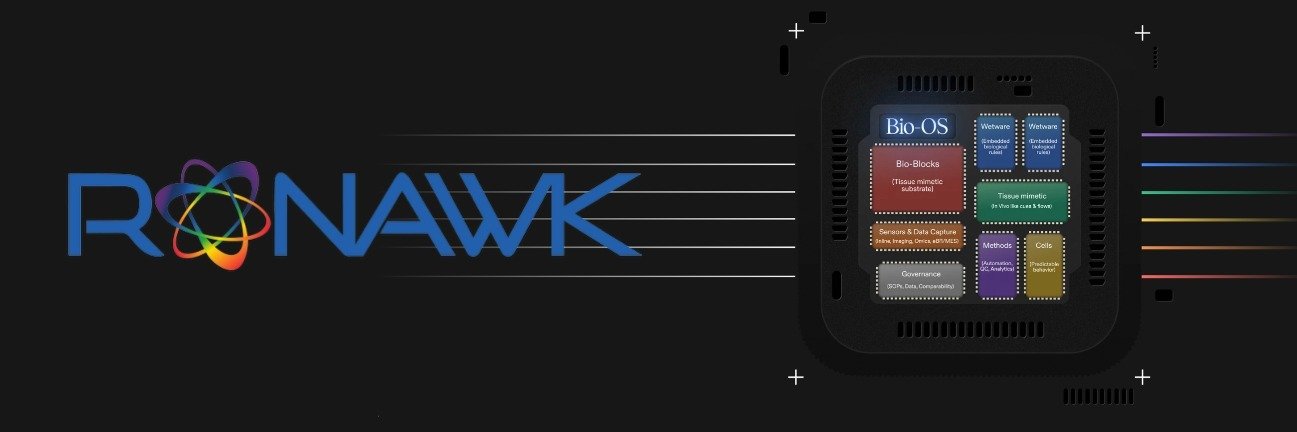
Bio-OS is a biological operating platform designed to coordinate biological environments, processes, and data across applications. It enables biology to be produced, assembled, studied, and scaled within a shared, governable framework. We are not standardizing biology, only the operating environment and metadata so biology becomes comparable.
A biological OS has three layers:
- Physical layer (“biological chips”): Human relevant, modular substrates (hydrogels, when treated as foundational materials rather than narrow tools, provide consistent and tunable environments in which biological systems can operate) for mammalian cells manufactured to the same specs everywhere so cells experience comparable environments across sites.
- Process layer (versioned “apps”): Copy and paste, version-controlled protocols that run on that physical layer, so methods are portable across labs, CDMOs, and federal facilities, rather than re-invented each time.
- Data layer (machine readable and regulator auditable): Built in sensing, standardized metadata, and traceable run histories, so every run can be compared, audited, and used for trustworthy model training.
Ronawk’s Bio-OS is a candidate implementation of this concept: Bio-Blocks as the tissue-mimetic physical layer; governed protocols and validated workflows as the process layer; and standardized sensing/metadata as the data layer designed to make mammalian cell culture and production reproducible, portable, and measurable.
Genesis risk register (biological reliability)
If Genesis trains on mammalian datasets generated under nonstandard environments and inconsistent metadata, the platform will inherit four predictable failure modes.
- Dataset shift will cause models that “perform” in one lab or facility context to degrade materially when deployed elsewhere.
- Confounding will drive models to learn proxies, reagent lots, instrument idiosyncrasies, local culture conditions, rather than underlying biology, producing high confidence but brittle conclusions.
- Site-to-site variance will inflate noise floors, force excessive replication, and undermine transferability of both assays and processes across the very networks Genesis aims to enable.
- Finally, weak auditability, incomplete provenance, non-uniform run manifests, and inconsistent QA/QC gates, will limit regulator and program owner trust, constrain model governance, and make it difficult to distinguish true biological signal from artifact at national scale.
Why this matters specifically for Genesis
The Genesis Mission is designed to harness federal scientific datasets, train foundation models, and deploy AI agents that can automate research workflows.
That vision depends on three conditions:
1. Comparable inputs: Foundation models do not become “truth engines” just because they are large. They become useful when the training data reflects stable, comparable reality. In mammalian biology, the reality today is not comparable across sites. Cultureware varies. Microenvironments vary. Protocol interpretation varies. Instrumentation and metadata vary. Even the same “cell type” behaves differently under subtly different environmental constraints.
If we do not fix this, Genesis will be forced to do what AI always does under inconsistent data conditions:
- Learn proxy variables,
- Overfit to lab specific artifacts,
- And fail when deployed in new contexts (the biological version of domain shift).
2. Repeatable biology to enable autonomous labs Genesis also aims toward AI agents and automated workflows. Autonomy requires a stable execution environment. In software, that stability is delivered by operating systems and standardized runtimes. In biology, we currently do “autonomy” on top of currently do “autonomy” on top of bespoke biology, meaning the agent can run the workflow, but you still cannot trust the output.
3. Trustworthy outputs that matter in the real world: The United States is now explicitly framing technology and standards, particularly in AI, biotech, and quantum computing, as drivers of global leadership. Genesis is part of that strategy. But strategy only becomes capability when it is implemented in systems that produce reliable outcomes. Bio-OS is a practical way to turn Genesis from an AI “brain” into an AI brain connected to standardized biological data provenance, calibration, measurement assurance, comparability libraries.
What Bio-OS changes: opportunity cost, time-to-result, modularity, capital efficiency
A standard biological OS is not a philosophical preference. It is an economic and operational lever.
Opportunity cost and time-to-result
When biology is nonstandard, teams spend time:
- Debugging instead of discovering,
- Transferring instead of producing,
- Repeating instead of learning.
Bio-OS is designed to compress that drag by making environments reproducible and protocols portable.
In multiple mammalian contexts, Bio-OS style architecture is reasonably positioned to deliver (grounded in demonstrated mammalian performance):
- Meaningful reductions in time-to-result (by reducing iteration cycles and failed runs),
- Higher effective yield per footprint (by improving cell performance in human relevant environments),
- Better run-to-run consistency (by standardizing the biological microenvironment),
- And lower CapEx for scale out (by enabling modular nodes rather than monolithic bespoke builds).
Modular production and capital efficiency
In the real world, especially for national security, capability must be deployable and replicable.
Bio-OS is built to support:
- Modular suites that can be deployed, validated, and replicated, standardizing the biological microenvironment),
- And lower CapEx for scale out (by enabling modular nodes rather than monolithic bespoke builds).
Modular production and capital efficiency
In the real world, especially for national security, capability must be deployable and replicable.
Bio-OS is built to support:
- Modular suites that can be deployed, validated, and replicated,
- Standardized nodes that can be networked,
- And rapid re-tasking when mission requirements change.
This is the central logic behind the national “network of facilities” concept: you do not win by building a single exquisite site. You win by deploying many standardized nodes that can surge and reconfigure quickly.
Concrete examples to anchor value
Example 1: BARDA / medical countermeasures (mAbs, antivirals, biologics)
In emergencies, timelines kill. When you scale a countermeasure across nonstandard facilities, you often lose months in:
- Process transfer,
- Comparability runs,
- Revalidation,
- And yield/stability surprises.
A shared biological OS architecture allows sites to run the same environment, same versioned process and same data schema, thereby compressing the time from “proof-of-concept” to “repeatable production.” In a crisis, that time compression is not incremental, it is lives and strategic resilience.
Example 2: Defense needs (biomaterials, field relevant biologics, adaptable production)
Defense problems do not arrive with 5-year lead times. A modular OS enables a campus of smaller suites to be repurposed in months rather than years, because the “operating layer” is consistent and transferable. That is how you create real surge capacity instead of paper surge capacity.
Lines of effort that connect Genesis to real world biology (and make it governable)
The United States is already structurally elevating biotech: coordination, strategy, standards, workforce, and investment. The missing piece is an execution architecture.
Here is the Bio-OS aligned implementation logic in five lines of effort:
- A Bio-OS demonstration network as the physical arm of Genesis: Stand up a small number of flagship nodes (federal lab, academic GMP/NAM, commercial CDMO) that produce standardized biological data, run standardized workflows, and serve as reference implementations across agencies and partners.
- Mission critical use cases with measurable outcomes: Pick a small set of use cases that matter (e.g., CHO mAb process comparability and NAM potency assay comparability) and measure time-to-result, variability, throughput/footprint, and auditability.
- Standards / data / AI integration: Publish schemas, metadata standards, and comparability libraries so Genesis models train on consistent biological representations.
- Workforce and bio-literacy as a deployment constraint: The workforce gap is real and worsening. Demand has surged while pipelines remain misaligned, and bio-literacy across institutions is uneven. A standardized OS reduces training burden because operators learn a stable “runtime,” not a different bespoke stack at every site.
- Capital alignment around platforms, not one-off projects: If federal investment is going to build durable capacity, it should capitalize platform architectures that scale across sites and missions, not just single purpose facilities.
A 12-36 month roadmap
0-6 months: Define metrics and launch pilots
Objective: Make “trustworthy biology for AI” measurable.
Actions:
- Convene a 60-90 minute working session (OSTP/Genesis leadership, DOE, DoD, NIH, FDA, NSF, NIST) to define pilot metrics: time-to-decision, batch variability, cost per qualified output, metadata completeness, and comparability across sites.
- Issue a pilot call (OTA/RFI structure is fine) requiring biological OS based architectures (Bio-OS as one candidate) with deliverables tied to the metrics above.
- Select three pilot sites to ensure domain transfer is tested:
- A federal research environment producing standardized datasets for Genesis,
- A translational/production environment aligned with countermeasures or biologics,
- A commercial or academic partner site to prove portability.
6-18 months: Run head-to-head trials and build comparability libraries
Objective: Prove whether standardized biology improves AI trustworthiness and operational performance.
Actions:
- Execute head-to-head runs comparing biological OS architectures against legacy approaches across at least two mammalian workflows.
- Build a comparability library: datasets and run metadata that quantify what is stable vs variable, across sites.
- Integrate results into Genesis training pipelines as a “clean biology” reference dataset.
18-36 months: Scale what works and embed standards
Objective: Turn pilot wins into repeatable national capability.
Actions:
- Expand from 3 sites to a broader demonstration network (5-7 nodes) if metrics justify it.
- Formalize biological OS aligned data schemas and auditing requirements through NIST/agency guidance.
- Create scalable procurement vehicles to replicate validated nodes rapidly across regions.
What each stakeholder gets
- Michael Kratsios / OSTP / Genesis Leadership: A concrete way to make Genesis outputs trustworthy in biology, not just impressive.
- Chris Wright / DOE: A “clean biology” data generation layer that strengthens foundation model training and enables autonomous workflows to be meaningful, not fragile.
- Dario Gil and Industry AI Leaders: Standardized biological runtimes that reduce domain shift and increase transferability, turning models into deployable capability.
- Ethan Klein / Emil Michael / Stephen Winchell (implementation and national capability): A modular, replicable architecture that supports scale out, procurement, and real timelines, not just research programs.
The immediate ask
As a concrete next step, I respectfully request that OSTP/Genesis leadership convene a 60-90 minute working session with DOE, DoD, NIH, FDA, NSF and NIST to determine whether, and how, to launch a 3-site biological operating system pilot within the next 12 months, with standardized metrics and head-to-head evaluation.
Model reliability and national program deadlines are critical. If we train Genesis on noncomparable biology, we will scale confidence without scaling truth.
Respectfully, Thomas W. Jantsch
President & COO, Ronawk, Inc.
President & COO, Ronawk, Inc.
On behalf of U.S. practitioners committed to a secure, resilient bio-industrial base
About Ronawk
At Ronawk, we are building a biological operating system (Bio-OS™) that acts as a compass for mammalian biology. Legacy biomanufacturing technologies were designed for microbes like yeast or bacteria. They exhaust mammalian cells, making production inefficient and cost prohibitive. Bio-OS was designed from the ground up for mammalian cells, which are the very cells needed for therapies, biologics, and regenerative medicine.
Instead of burning cells out, Ronawk’s Bio-OS cultivates them in environments that mimic the body. This yields healthier, more potent outputs at a fraction of the cost and footprint of current systems. Find us online at ronawk.com, X (Twitter), and LinkedIn.
Ronawk Media Contact
Scott Leigh
Chief Business Development Officer
+1 (913) 302-4792