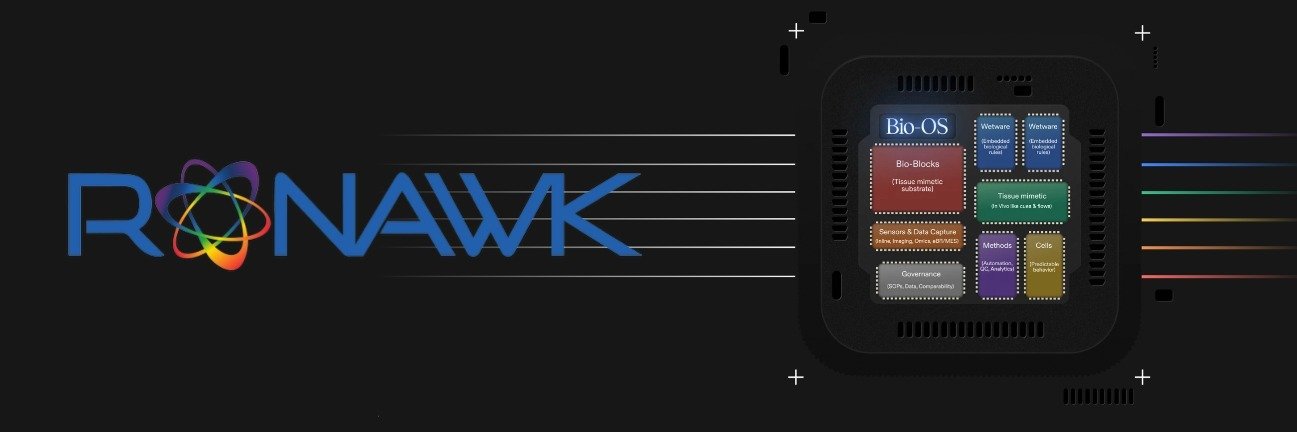
Bio-OS™ and the Emergence of Biological Operating Infrastructure
A White Paper by A.J. Mellott, PhD, CEO & Co-Founder of Ronawk®
February 2, 2026
Executive Summary
Foundational materials alone do not create ecosystems. Platforms do.
In Hydrogels as Infrastructure, Ronawk articulated why hydrogels represent an emergent class of foundational materials for biology, materials capable of supporting scale, reproducibility, and governance once they become standardizable. This second paper builds directly on that premise.
Here, we introduce Bio-OS™ as the operating platform that transforms standardized hydrogel environments into an operable biological system for production, assembly, observation, and discovery. Bio-OS enables biological systems to be built from interoperable components, coordinated through shared operational logic, and observed under conditions that are In Similare, similar to the human body.
This progression mirrors a familiar industrial pattern. When materials mature and standards emerge, components become possible. Platforms arise to organize those components. Applications and industries follow. Bio-OS represents this platform layer for biology.
1. From Materials to Components to Platforms
Across industrial history, the transition from material to platform has followed a repeatable structure.
Steel did not enable infrastructure simply because it was strong. It enabled infrastructure because standards allowed components and sub-components such as beams, joints, rails, and fasteners to be fabricated interchangeably. Once components could be trusted, complex systems could be assembled without reliance on individual craftsmen.
Silicon followed a similar path. Semiconductor fabrication enabled standardized components such as transistors, logic gates, and integrated circuits. As control and arrangement improved, abstraction layers emerged. Hardware complexity became separable from function, allowing software ecosystems and computing platforms to form.
In both cases, standards and governance transformed materials into components, and components into platforms.
Biology has historically lacked this progression.
Hydrogels, as foundational materials, now make it possible.
2. Hydrogels as Biological Hardware
Hydrogels possess a defining property that makes them suitable as a foundational biological material: They function as conductive environments for biological matter.
They mediate the movement of:
- Water through osmosis.
- Ions and molecules through diffusion.
- Mechanical forces through viscoelastic transmission.
These properties do not control biology. They enable biological processes to occur within defined physical contexts, the same contexts that shape cellular behavior in vivo.
When hydrogels are used in an amorphous or bespoke manner, they function primarily as environments, useful, but limited. When structure, geometry, and connectivity are intentionally fabricated into hydrogels, their conductive properties can be directed rather than incidental. Water, ions, molecules, and forces move through architected pathways governed by physical design rather than chance.
At this point, a logical framework emerges.
Structured hydrogels can be treated not merely as passive media, but as biological hardware components. They distribute biological matter and signals in reproducible ways, allowing transport pathways, mechanical gradients, and spatial organization to become repeatable rather than incidental.
This is what makes biological processes composable.
Composability allows systems to scale. When biological hardware components can be assembled, recombined, and extended without reengineering the underlying material logic, biology can move beyond isolated cultures toward integrated systems.
This is the moment when biological infrastructure becomes operable, and when platforms become possible.
3. Organizing Components Through Operational Logic
Components alone do not create platforms. They must be coordinated through shared rules, interfaces, and workflows.
In computing, standardized hardware components only became broadly useful once operating logic emerged that allowed them to be programmed, orchestrated, and recombined across use cases. That operating logic did not replace hardware. It made hardware usable at scale.
The same pattern holds in biology.
When biological components are governed by consistent operational frameworks, environments can be reproduced across experiments, facilities, and applications. Processes become comparable. Learning accumulates rather than fragmenting across isolated workflows.
It is at this layer that a biological operating system becomes necessary.
Within such a system, the organizing logic defines how biological components are used, not what outcomes must occur. It establishes repeatable conditions for production, assembly, observation, and iteration, while allowing biological systems to adapt and self-organize within those conditions.
At Ronawk, this organizing layer is referred to as Bio-OS.
This distinction is essential. Platforms do not dictate biological behavior. They make biological behavior interpretable, comparable, and scalable.
4. The Living Interface: Biology Engaging with Infrastructure
The final layer of any biological platform is the living system itself.
When cells interact with structured, conductive environments, they do not simply occupy space. They actively remodel, respond to, and organize their surroundings. Over time, complex microenvironments emerge that reflect the physical, chemical, and spatial relationships found in native tissues.
This interaction between living systems and infrastructure is where much of biology’s potential has historically been inaccessible. Traditional culture systems often obscure these dynamics rather than support them.
When biological components, operational logic, and living systems are aligned, biology can be observed as it functions rather than as it is forced to adapt. Production, tissue assembly, data generation, and behavioral testing can occur within a single coherent framework.
This alignment enables biology to be studied, engineered, and translated across multiple domains, including regenerative medicine, diagnostics, preventive health, agriculture, materials science, and biological defense.
5. Data, Standards, and AI-Ready Biology
One of the most consequential outcomes of standardization is data reliability.
When biological environments are inconsistent, data becomes noisy and difficult to compare. When environments are standardized and governed, biological signals become cleaner, more interpretable, and more comparable across experiments and sites.
Bio-OS enables:
- Consistent data generation from live cells and tissues.
- Multi-parametric observation from unified biological systems.
- Reduced experimental fragmentation
This reliability is a prerequisite for advanced analytics and artificial intelligence. AI does not require more data. It requires better data. Standardized biological infrastructure allows data to accumulate rather than reset, enabling learning to compound over time.
6. Bio-OS as a Platform, Not a Product
The convergence of:
- Standardized biological materials,
- Interoperable hardware components,
- Governed operational logic,
- Dynamic interaction with living systems, creates a biological platform, not a single solution.
In this sense, Bio-OS mirrors a familiar structural role seen in other industries. Platforms do not invent outcomes. They create the conditions under which many outcomes can be explored, compared, and scaled.
Bio-OS does not dictate biological behavior. It makes complex biology operable, interpretable, and extensible across use cases.
This distinction is critical. Platforms enable innovation without prescribing it.
7. From Platform to Ecosystem
Platforms do not scale by doing everything themselves. They scale by enabling others.
Because Bio-OS provides a shared, governable foundation, new applications can be developed without redefining the material or operational layer each time. Distinct efforts can focus on therapeutics, diagnostics, biomaterials, health span, regenerative medicine, or other domains while remaining interoperable at the infrastructure level.
This is how platforms give rise to ecosystems.
Ecosystems are not centrally designed. They emerge when coordination becomes easier than improvisation, and when shared capability allows specialization to flourish without fragmentation.
Conclusion: Operationalizing Biological Infrastructure
Hydrogels provide the foundational material layer.
Standardized components make that material operable.
Bio-OS provides the operational logic that coordinates them.
Together, they transform biological infrastructure into a usable platform.
This paper does not claim inevitability. It describes a structural transition that has appeared repeatedly across industrial history: when materials mature, platforms emerge, and ecosystems follow.
The next paper explores what happens once platforms are in place.
About Ronawk
At Ronawk, we are building a biological operating system (Bio-OS™) that acts as a compass for mammalian biology. Legacy biomanufacturing technologies were designed for microbes like yeast or bacteria. They exhaust mammalian cells, making production inefficient and cost prohibitive. Bio-OS was designed from the ground up for mammalian cells, which are the very cells needed for therapies, biologics, and regenerative medicine.
Instead of burning cells out, Ronawk’s Bio-OS cultivates them in environments that mimic the body. This yields healthier, more potent outputs at a fraction of the cost and footprint of current systems. Find us online at ronawk.com, X (Twitter), and LinkedIn.
Ronawk Media Contact
Scott Leigh
Chief Business Development Officer
+1 (913) 302-4792