A Materials Maturity Framework for the Next Era of Biology
A White Paper by A.J. Mellott, PhD, CEO & Co-Founder of Ronawk®
January 13, 2026
Executive Summary
Every major era of progress has been shaped not only by discovery, but by the maturation of a foundational material.
Stone enabled tools.
Steel enabled infrastructure.
Silicon enabled computation.
Steel enabled infrastructure.
Silicon enabled computation.
In each case, transformation did not occur simply because a new material existed. It occurred when that material became reliable, standardized, and governable, allowing shared rules, interfaces, and abstractions to form. Once standards emerged, complexity could be managed, coordination became possible, and entire industries followed.
Biology is approaching its own materials moment.
Despite extraordinary advances in molecular biology, cell engineering, and analytics, the life sciences remain constrained by materials and workflows that were never designed to support scale, reproducibility, or coordination across organizations. Hydrogels have emerged as a powerful class of biological materials, yet they are most often framed narrowly as drug delivery systems or bioinks.
This white paper proposes a broader and more consequential perspective:
Hydrogels represent an emergent foundational material layer for biological infrastructure.
As hydrogels mature into standardizable, interoperable environments, they create the conditions for governance, abstraction, and operational logic to emerge. This transition marks the threshold at which platforms become possible, and with them, scalable biological systems and industries.
1. Materials Maturity and the Rise of Infrastructure
Infrastructure does not arise from innovation alone. It arises when a material becomes reliable enough to support coordination at scale.
Steel did not reshape society simply because it was stronger than iron. Its impact came when standards were established, allowing components to be produced interchangeably rather than crafted individually. Once steel could be trusted, measured, and governed, bridges, railways, buildings, and factories could be assembled from standardized parts rather than bespoke workmanship. Infrastructure emerged, and with it, entirely new industries.
Silicon followed a similar trajectory. Its true impact did not stem from the raw material itself, but from the ability to fabricate it reproducibly, define standards, and build abstraction layers that separated physical complexity from functional use. That progression enabled semiconductors, computing platforms, and eventually modern digital ecosystems.
In each case, the same pattern appears:
- A material matures.
- Standards and governance become possible.
- Abstraction layers emerge.
- Platforms form.
- Industries scale.
Biology today resembles an earlier phase of this trajectory. Innovation is rapid, but infrastructure remains fragmented. Biological workflows are often bespoke, difficult to reproduce across sites, and highly sensitive to context. Progress is limited not by insight, but by the absence of a shared, governable material foundation.
2. Why Hydrogels Have Been Underestimated
Hydrogels are commonly associated with a narrow set of applications:
- Injectable delivery matrices.
- Scaffolds for localized repair.
- Bioinks for additive manufacturing.
These uses are important, but they obscure the deeper significance of the material.
Hydrogels are not merely carriers.
They are environments.
They are environments.
Living systems respond not only to molecular signals, but to physical context, spatial organization, mechanics, and boundary conditions. In biology, environment is not background. It is an active participant in behavior, interaction, and fate.
What has been underappreciated is not that hydrogels can support biology, but that hydrogels can be defined, tuned, and reproduced as environments. This capability places them in a fundamentally different category from many traditional biological substrates.
When environments can be specified and repeated, biology becomes comparable across experiments, sites, and time. This is the first prerequisite for infrastructure.
3. Materials Maturity in Biology
The analogy to steel or silicon is not about control or determinism.
Steel is inert.
Biology is adaptive.
Biology is adaptive.
The parallel lies in materials maturity, the point at which a material becomes sufficiently stable, integrable, and dependable to support systems rather than isolated experiments.
In biology, materials maturity does not eliminate biological variability. Instead, it reduces extrinsic variability, the variability introduced by tools, environments, and workflows. When that variability is reduced, intrinsic biological behavior becomes more interpretable and reproducible.
Materials maturity in biology therefore implies:
- Standardizable environments.
- Interoperable formats.
- Governed interfaces.
- The ability to build abstraction layers.
Hydrogels are now approaching this threshold. When properly designed as part of a system, they shift from experimental substrates to infrastructural components.
4. Hydrogels as a Foundation for Standards and Governance
Infrastructure requires trust. Trust requires standards.
When hydrogels are treated as foundational materials rather than ad hoc tools, it becomes possible to define shared rules for how biological environments are constructed, characterized, and used. This, in turn, enables governance, comparability, and scale.
Standardized hydrogel environments allow:
- Reproducible biological behavior across sites.
- Meaningful comparison of data between experiments.
- Coordinated workflows across teams and organizations.
- The emergence of shared operational logic.
This is not about replacing existing technologies such as bioreactors or analytical platforms. It is about stabilizing and extending them by providing a consistent material context in which biology operates.
In this sense, hydrogels function not as endpoints, but as enablers of biological infrastructure.
5. Relational Biology and New Biomanufacturing Modalities
Biology does not operate in isolation. Biological behavior emerges from relationships: between cells, between tissues, between signals, and between physical environments.
Traditional biological systems often reduce this complexity for the sake of control or throughput. While effective for certain applications, these approaches limit access to higher-order behaviors that arise through interaction and organization.
Hydrogels expand this design space.
When architected as systems, hydrogels support the establishment and maintenance of biological relationships in a controlled and reproducible manner. This enables new modalities across biomanufacturing, modeling, and discovery.
As biological production expands to include diverse cell types, tissues, and biologically derived products, no single format will fit all use cases. Standardized hydrogel environments allow context-appropriate systems to be deployed without redefining the material foundation each time.
6. Data, Consistency, and the Preconditions for Scale
One of the persistent challenges in biology is data inconsistency. Fragmented environments lead to fragmented data, limiting interpretability and downstream use.
Standardized biological environments create the conditions for consistent, high-quality data generation. When structure, context, and process are aligned, biological signals become more reliable and comparable.
This consistency is a prerequisite not only for scale, but for advanced analytics and computational approaches. Reliable data from living systems enables learning to accumulate rather than reset, allowing biology to be interrogated, modeled, and translated more effectively.
7. From Foundational Materials to Platforms
Foundational materials alone do not create ecosystems. Platforms do.
However, platforms cannot exist without materials mature enough to support standards, governance, and abstraction. Hydrogels represent the material layer at which this transition becomes possible in biology.
Once environments can be standardized and governed, an operational layer is required to coordinate them. That operational logic does not belong to the material itself. It belongs to the platform that organizes it.
This is the transition point where materials become infrastructure, and infrastructure becomes usable at scale.
Conclusion: A Threshold Moment for Biology
Hydrogels are at the beginning of their materials maturity curve. Their greatest impact will not be realized through isolated applications, but through their role as a foundational layer for biological infrastructure.
As standards emerge and environments become governable, new operational frameworks become possible. These frameworks enable platforms, and platforms enable ecosystems.
Biology appears to be approaching this threshold.
This is not a claim of dominance.
It is a recognition of readiness.
It is a recognition of readiness.
Respectfully, A.J. Mellott, PhD
CEO & Co-Founder, Ronawk, Inc.
CEO & Co-Founder, Ronawk, Inc.
About Ronawk
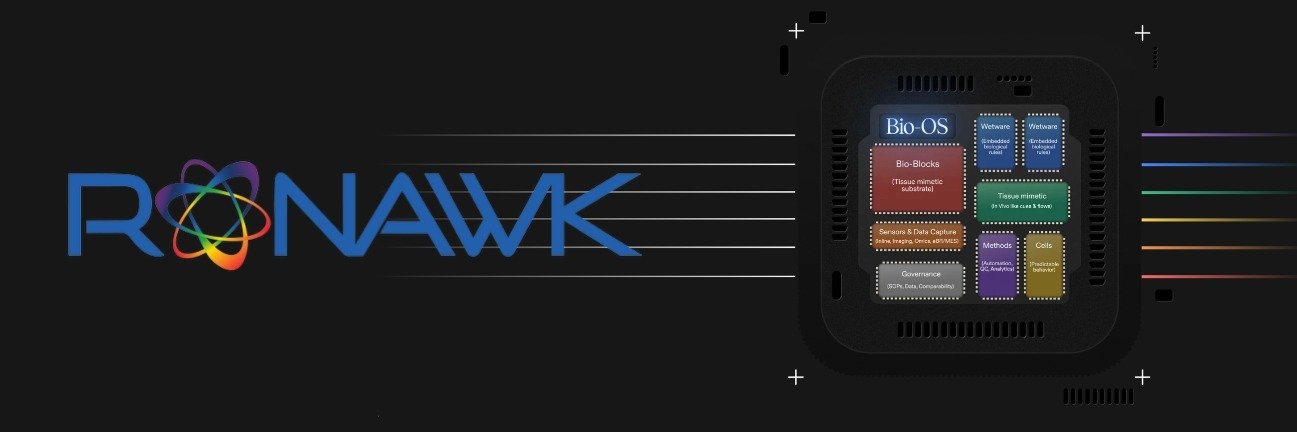
At Ronawk, we are building a biological operating system (Bio-OS™) that acts as a compass for mammalian biology. Legacy biomanufacturing technologies were designed for microbes like yeast or bacteria. They exhaust mammalian cells, making production inefficient and cost prohibitive. Bio-OS was designed from the ground up for mammalian cells, which are the very cells needed for therapies, biologics, and regenerative medicine.
Instead of burning cells out, Ronawk’s Bio-OS cultivates them in environments that mimic the body. This yields healthier, more potent outputs at a fraction of the cost and footprint of current systems. Find us online at ronawk.com, X (Twitter), and LinkedIn.
Ronawk Media Contact
Scott Leigh
Chief Business Development Officer
+1 (913) 302-4792