How Biological Platforms Enable the Emergence of Ecosystems
A White Paper by A.J. Mellott, PhD, CEO & Co-Founder of Ronawk®
February 24, 2026
Executive Summary
Industries do not emerge from products alone. They emerge when reliable infrastructure makes coordination possible.
Across history, periods of profound industrial transformation have followed a recurring pattern. First, a foundational material or capability matures to the point where it can be trusted at scale. Next, platforms arise that organize activity around that foundation. Only then do specialized companies, markets, and ecosystems form organically.
Steel followed this path, enabling transportation networks, cities, manufacturing, and global trade. Silicon followed a similar trajectory, giving rise to computing, software, communications, and, eventually, artificial intelligence.
Biology, despite extraordinary scientific progress, has struggled to follow this pattern. Innovation has advanced faster than infrastructure. As a result, biological breakthroughs often remain isolated, difficult to scale, and challenging to coordinate across organizations and industries.
Recent advances in biological materials and platforms suggest this constraint is beginning to lift.
This paper explores how biological infrastructure, once operationalized through platforms, creates the conditions under which entire industries can emerge. Rather than proposing specific outcomes, it examines how reliability, standardization, and coordination in biology expand what becomes possible, and why biology now appears to be approaching a new industrial inflection point.
1. A Repeating Pattern in Human Progress
When foundational capabilities become reliable, human systems reorganize around them.
Steel allowed mechanical load to be distributed predictably, enabling infrastructure to extend beyond craftsmanship. Silicon allowed electrical information to be controlled and abstracted, enabling computation to move beyond laboratories and into everyday life.
In each case, the most significant impacts were not immediate or singular. They unfolded as new industries formed atop shared foundations. Transportation, energy, manufacturing, computing, communication, and intelligence were not designed in advance. They emerged.
This pattern reflects a broader principle: Infrastructure does not dictate outcomes, but it defines the space of what can be built.
2. Why Biology Has Lagged at the Industrial Scale
Biology has advanced rapidly at the level of discovery, but industrial coherence has lagged.
Biological systems are deeply contextual. Small differences in environment, process, or handling can produce large differences in outcome. Without shared, governable infrastructure, coordination becomes expensive and fragile.
As a result, biological innovation often progresses through isolated successes rather than compounding systems. Breakthroughs occur, but they do not always translate into scalable industries.
This is not a failure of science. It is a structural limitation.
Industries tend to emerge only after shared infrastructure makes coordination easier than improvisation.
3. Infrastructure as the Turning Point
Infrastructure changes what is economically and organizationally possible.
When biological environments, components, and workflows become reliable and comparable, the cost of coordination drops. Specialization becomes viable. Learning accumulates across organizations rather than resetting with each effort.
At this point, biology begins to behave less like a collection of bespoke experiments and more like an industrial domain.
This transition does not require central planning. It occurs when shared capability reaches a threshold of trust.
4. Platforms as Catalysts for Emergence
Platforms play a distinct role in this transition.
They do not define end applications. They organize shared foundations so that many different applications can be pursued independently without fragmentation.
In biology, platforms that coordinate materials, components, environments, and data create a substrate upon which diverse industries can form. The platform’s value lies in stability and extensibility, not in control.
Once such platforms exist, the pace and breadth of biological innovation expand dramatically.
5. Industries That Become Possible
When biological infrastructure reaches this level of maturity, entire classes of industry become practical in ways that were previously limited or infeasible.
These include, for example:
- Biomanufacturing, where cells, tissues, and biologics can be produced with consistency, scalability, and resilience across distributed facilities.
- Medicine and regenerative therapies, where human-relevant biological systems enable more predictive development, personalized treatment strategies, and long-term tissue restoration.
- Pandemic preparedness and biosecurity, where rapid modeling, testing, and response to biological threats can occur within standardized platforms rather than ad hoc systems.
- Artificial intelligence applied to biology, where reliable, high-quality data from living systems enables machine learning to accelerate discovery, translation, and optimization.
- Food and agricultural systems, including closed-loop and extreme-environment production, where biological platforms support resilient food supply chains and even off-world habitation.
These examples are not forecasts. They are logical consequences of reliable biological infrastructure, much as railways, power grids, software ecosystems, and AI followed earlier material revolutions.
6. Compounding Effects Across Society
As biological platforms mature, compounding effects emerge.
Data becomes comparable across domains. Talent specializes rather than generalizes. Capital flows toward systems rather than isolated efforts. Translation from discovery to deployment accelerates.
Over time, biology becomes not just a scientific discipline, but a coordinated industrial capability.
This is how previous infrastructure revolutions reshaped economies and societies.
7. Biology’s Moment
Infrastructure revolutions are rare. They occur when materials, standards, and platforms align.
Biology now appears to be approaching such a moment.
Not because discovery has slowed, but because the absence of infrastructure has become the limiting factor. As that constraint lifts, the range of possible industries expands dramatically.
This paper does not claim ownership of that future. It describes a structural inflection point that history suggests will give rise to many futures.
Conclusion: Infrastructure Enables Emergence
Steel enabled the modern industrial world.
Silicon enabled the information age.
Biological platforms now have the potential to enable the next great expansion of human capability.
Where infrastructure stabilizes, platforms organize.
Where platforms organize, industries emerge.
Biology’s moment appears to be arriving.
Respectfully, A.J. Mellott, PhD
CEO & Co-Founder, Ronawk, Inc.
CEO & Co-Founder, Ronawk, Inc.
About Ronawk
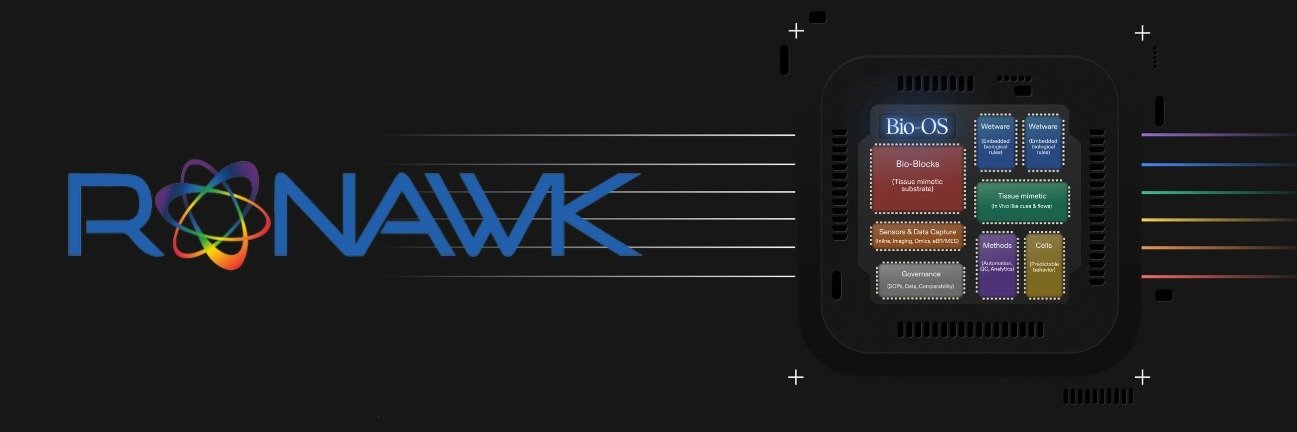
At Ronawk, we are building a biological operating system (Bio-OS™) that acts as a compass for mammalian biology. Legacy biomanufacturing technologies were designed for microbes like yeast or bacteria. They exhaust mammalian cells, making production inefficient and cost prohibitive. Bio-OS was designed from the ground up for mammalian cells, which are the very cells needed for therapies, biologics, and regenerative medicine.
Instead of burning cells out, Ronawk’s Bio-OS cultivates them in environments that mimic the body. This yields healthier, more potent outputs at a fraction of the cost and footprint of current systems. Find us online at ronawk.com, X (Twitter), and LinkedIn.
Ronawk Media Contact
Scott Leigh
Chief Business Development Officer
+1 (913) 302-4792